
The Utility Advantage: A Commercial Buyer’s Guide to Solar Farm Investments in Saudi Arabia
The energy landscape across the Gulf Cooperation Council (GCC) is undergoing a profound transformation, driven by national economic mandates. For decades, regional economies relied heavily on fossil fuels—a reliable source that simultaneously presented geopolitical and environmental risks. Today, the narrative has decisively shifted. The question for Gulf businesses operating in industrial centers like Jubail or the Eastern Province is no longer whether to invest in solar; it is how quickly you can recover your capital and begin treating energy as a competitive advantage rather than an overhead cost.
For commercial buyers considering large-scale power generation assets, understanding the difference between simply installing panels on a corporate compound roof and developing a massive utility-scale solar farm is critical. These are not merely technological investments; they are foundational infrastructure plays that redefine operational efficiency, secure long-term energy supply, and directly support national economic diversification goals under Vision 2030.
This guide provides an investment consultancy perspective on evaluating the viability, technology choices, and strategic roadmap required to participate in the rapidly expanding utility-scale solar market, particularly within the unparalleled resource setting of Saudi Arabia.
What is a Utility-Scale Solar Farm? Beyond Compounds
To understand true commercial scale, one must first differentiate between various forms of solar power generation. The distinction determines the investment size, the technical complexity, and most importantly, the rate of return on capital (ROI).
Defining the Scale Differential
- Residential/Compound Solar: These systems are designed for individual consumers or small compounds. They operate at a localized level, optimizing power consumption directly within the building envelope. The focus is on offsetting immediate household loads.
- Commercial Rooftop Solar: This scale targets single facilities (e.g., a manufacturing plant in KAEC or corporate campus). While highly valuable for risk mitigation and reducing transmission losses, the physical limitation of existing roof space constrains the total generation capacity.
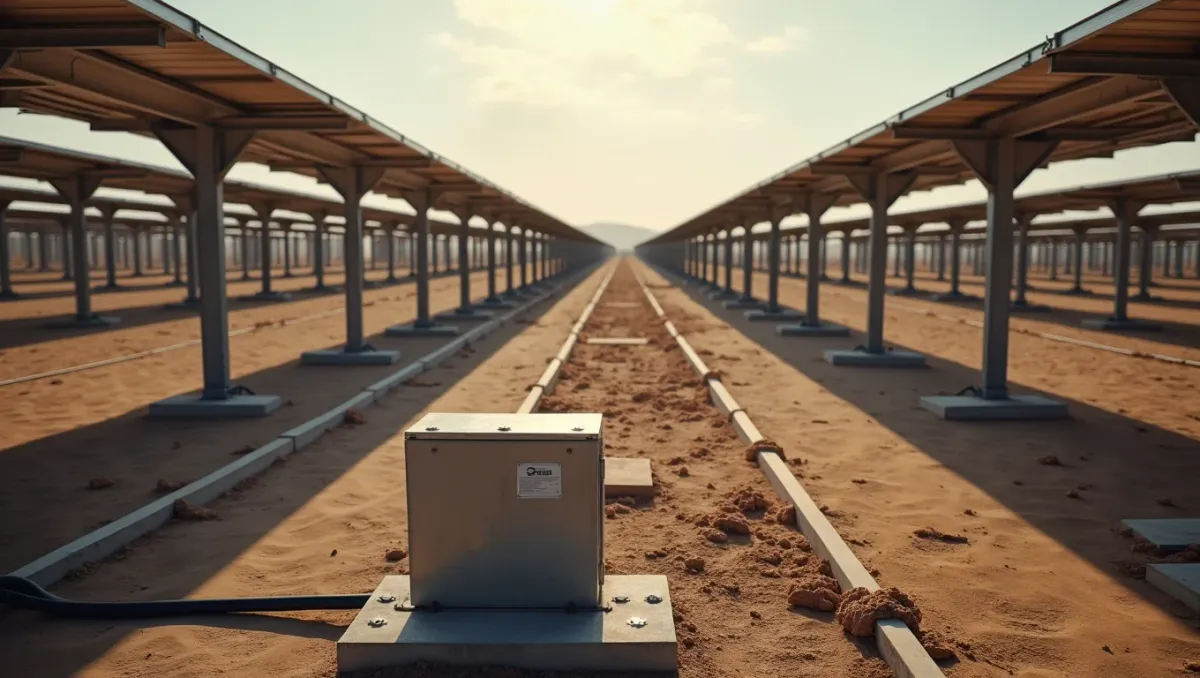
- Utility-Scale Solar Farms: These are massive, ground-mounted installations—often covering hundreds of acres—designed to generate power at a grid level, feeding into national high-voltage transmission lines operated by entities like SEC. They function as independent, centralized power plants.
The Business Case for Scale
From an investment standpoint, utility-scale solar farms offer unparalleled economies of scale. When generation capacity reaches the gigawatt (GW) level, the cost per megawatt is optimized by leveraging industrial-grade equipment and sophisticated grid connection infrastructure. The primary business advantage here is stability: generating vast amounts of predictable power allows major industrial consumers—such as those in petrochemical complexes—to budget for energy costs with greater accuracy and secure a long-term supply that insulates them from fluctuating fossil fuel prices.
Furthermore, these mega-projects are inherently designed around 3-phase power distribution, allowing them to handle the massive electrical loads characteristic of industrial operations (e.g., large compressors, processing plants). This robust architecture ensures minimal operational downtime and maximum reliability, which is paramount for commercial continuity in demanding markets like Riyadh or Jeddah.
Why Is Saudi Arabia a Global Powerhouse for Solar Energy?
Saudi Arabia's ambition to diversify its economy away from oil has positioned it at the forefront of the global energy transition. The development of massive solar infrastructure is not just an environmental initiative; it is a core economic pillar supporting national resilience and meeting aggressive sustainability targets set forth by Vision 2030.
The Resource Advantage: Direct Normal Irradiance (DNI) & Climate
The single most compelling factor for any energy investor is resource quality. Saudi Arabia possesses immense, consistent solar irradiance, particularly high levels of Direct Normal Irradiance (DNI). DNI refers to the maximum amount of solar power received on a surface perpendicular to the sun’s rays—the ideal condition for efficient power conversion. This world-class resource provides an average annual output of 5.5–6.5 kWh/m²/day across many key regions, dramatically improving plant capacity factors and minimizing generation variability compared to other global zones.
The sheer scale of the desert expanse, coupled with consistent irradiance, further mitigates supply chain risks associated with acquiring suitable development sites in the Najd plain or other optimal locations. The climate, while presenting challenges like haboob storms and fine desert sand accumulation, is overwhelmingly advantageous for solar power generation.
Driving Demand Through Mega-Projects
The commitment demonstrated by national mega-projects—including those in NEOM and the Red Sea region—is setting new regional benchmarks for solar farm capacity. These initiatives are establishing entirely new industrial ecosystems powered by renewable energy. This massive, sustained demand signals to commercial buyers that the market is mature, de-risked, and backed by sovereign commitment. Participating in this ecosystem allows businesses to secure power purchase agreements (PPAs) with robust backing from major grid operators.
The focus on large utility-scale projects ensures that the resulting infrastructure meets international standards for capacity, safety, and grid integration, thereby guaranteeing high operational efficiency for all commercial users connected to the national network.
Technical Deep Dive: Choosing the Right Technology (PV vs. CSP) for Mega Projects
When developing a multi-hundred megawatt solar farm, developers must select between two primary mature technologies: Photovoltaic (PV) and Concentrated Solar Power (CSP). The "best" choice is not universal; it depends critically on the required dispatch profile—that is, whether the power needs to be available when the sun isn't shining.
Photovoltaic (PV) Technology
PV technology converts sunlight directly into electricity using semiconductor materials. It is characterized by high conversion efficiency and rapid deployment timelines. For most modern utility-scale deployments, PV remains the preferred method due to its proven scalability and decreasing levelized cost of energy (LCOE). Its modular nature allows for phased investment and scaling as needed.
However, standard PV output ceases when the sun sets. To manage this intermittency, large-scale PV farms must be paired with robust, grid-level battery energy storage systems (BESS) to ensure continuous power delivery—a critical requirement for maintaining operational efficiency in industrial settings that require stable electrical supply.
Concentrated Solar Power (CSP) Technology
CSP involves using mirrors (heliostats) to concentrate sunlight onto a receiver, generating heat. This heat then drives a conventional steam turbine to produce electricity. The key advantage of CSP is its inherent ability to integrate thermal energy storage (molten salts).
From an investment standpoint, the inclusion of thermal storage means that a CSP plant can generate predictable power hours after sunset—effectively providing "dispatchable" renewable energy without needing a separate battery system. This capability makes it highly valuable for industrial loads that operate 24/7 and require absolute baseload certainty.
Strategic Recommendation for KSA
For Saudi Arabia, the choice must align with economic goals and load profiles. While PV paired with advanced BESS offers rapid deployment and lower initial capital expenditure (CapEx), CSP’s unique ability to provide predictable, baseload power through thermal storage makes it highly attractive where absolute supply certainty is the top priority for core industrial processes.
The optimal modern strategy often involves a hybrid approach: utilizing the speed and scalability of PV while integrating advanced BESS or strategically incorporating CSP elements to manage intermittency and guarantee reliable, continuous power delivery for critical commercial operations.
The Investment Roadmap: What Developers Need to Know About Building Solar Farms in KSA
Entering the utility-scale solar market requires navigating complex regulatory, technical, and financial milestones. Success depends on treating the development process as a phased engineering project, not merely a construction endeavor. Investors must adopt a highly structured approach from concept to commissioning.
Phase 1: Feasibility Studies and Resource Assessment
The initial stage involves detailed site assessment. This goes beyond simply measuring solar irradiance; it requires geotechnical surveys, grid interconnection point analysis, and environmental impact studies tailored for the local climate—specifically analyzing dust accumulation rates (soiling) and saline corrosion risks in coastal areas like Jeddah or Dammam.
Key Deliverable: The Power Purchase Agreement (PPA) framework must be defined here, establishing clear terms for power delivery, pricing mechanisms, and revenue certainty. This PPA is the financial backbone of the investment.
Phase 2: Design Engineering and Grid Interconnection
This phase translates resource potential into a physical blueprint. Engineers design the optimal layout of arrays (considering land use efficiency, shading analysis, and access roads) and calculate the necessary electrical infrastructure—including transformers, switchgear, and medium/high-voltage substations required for connection to the SEC grid. The grid interconnection challenge is paramount: the generated power must connect seamlessly to the national transmission network while adhering to stringent system operator codes.
A successful design minimizes resistive losses and ensures that the plant’s output profile complements existing regional load demands, maximizing overall grid stability and operational efficiency for all connected industrial users.
Phase 3: Procurement, Construction, and Commissioning
This is the execution phase. Procurement must focus on industrial-grade components suitable for extreme desert environments (e.g., specialized tracking systems and high-durability inverters rated for dust/heat). Construction involves managing large workforces and adhering to tight safety standards.
Crucially, commissioning involves rigorous testing of the entire system—from the individual panel modules to the substation transformers—under simulated and real-world load conditions. This final validation confirms that the plant meets its guaranteed output specifications.
Lifecycle Management: Maintenance Planning and Operational Excellence
An investment's true ROI is determined not by its initial build cost, but by its operational lifetime performance. Commercial buyers must factor in maintenance planning from day one. Key lifecycle considerations include:
- Cleaning Protocols: The fine desert sand and dust require scheduled cleaning to mitigate soiling losses, ensuring maximum irradiance capture efficiency (kWh/m²/day).
- Component Degradation Modeling: Assessing the predictable degradation rate of panels and inverters over decades allows for proactive capital expenditure planning.
- Preventative Maintenance Scheduling: Establishing cyclical inspection schedules for electrical components, tracking systems, and power electronics minimizes unexpected downtime (O&M costs).
By integrating these lifecycle cost analyses into the initial investment model, developers can mitigate operational risks and secure predictable cash flows over the project's 25+ year lifespan.
Key Takeaways
- Utility-scale solar farms represent foundational infrastructure investments, offering economies of scale far exceeding commercial rooftop solutions.
- Saudi Arabia’s superior DNI and national mega-project commitments de-risk investment and guarantee long-term market demand backed by sovereign mandate.
- The optimal technical strategy often involves a hybrid approach (PV + BESS or CSP) to manage intermittency and ensure predictable, dispatchable power for industrial loads.
- Successful development requires meticulous planning across three phases: feasibility (PPA definition), engineering (grid integration with SEC standards), and lifecycle management (O&M).
Related articles
- Understanding the Giants: How Mega Solar Plants Are Powering Saudi Arabia’s Future
- Powering Tomorrow: Saudi Arabia’s Pivotal Shift to Renewable Energy
- Finding Your Path to Energy Independence: A Homeowner’s Guide to Selecting a Top Solar Installer in the Kingdom of Saudi Arabia
- Optimizing Home Comfort: Heating Efficiency in the Arabian Gulf Climate
- Optimizing Industrial Resilience: A Buyer’s Guide to Battery Storage for Commercial Solar in the Arabian Gulf
Explore topics: Utility Scale, Gulf, Renewable Energy
The information in this article is for educational purposes only. Always verify specifications, availability, and suitability with a qualified supplier or engineer before making purchasing or installation decisions.



