
Inductive Energy Storage: Mastering Magnetic Fields for Advanced Grid Stabilization in the Arabian Gulf
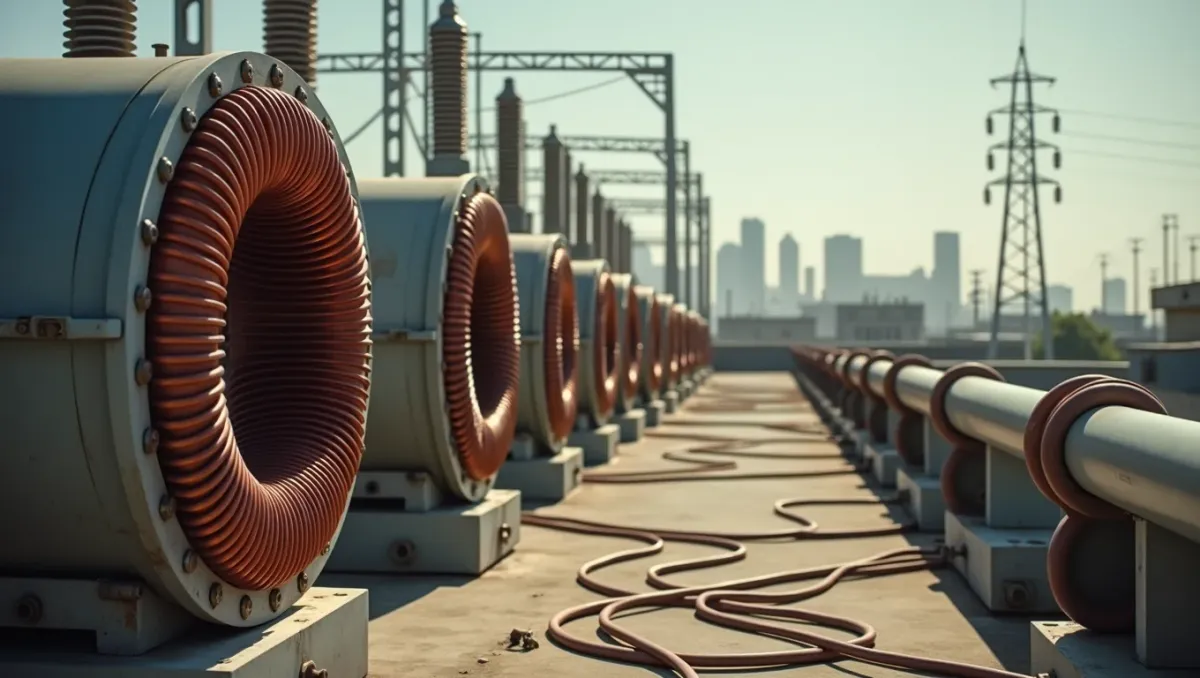
In modern power systems architecture, the concept of energy storage has evolved far beyond simple battery bank deployment. While lithium-ion chemistry dominates residential and commercial compounds across the Arabian Gulf—from villas in Jeddah to new developments in Riyadh—utility-scale mega-projects demand a comprehensive understanding of every energy conversion mechanism available. This is particularly true for advanced infrastructure development in the UAE, or massive industrial zones like Jubail and KAEC.
Engineers must analyze the fundamental physics governing diverse storage mediums. Among these mechanisms, inductor-based storage represents a critical, yet often misunderstood, pillar of power electronics. It is not merely an auxiliary component for filtering; it is a robust method for temporarily storing significant amounts of energy within a controlled magnetic flux density. Understanding this principle allows grid operators to manage transient voltage dips, regulate harmonic distortion, and compensate reactive power with unmatched precision across the Arabian Peninsula.
Understanding Inductive Energy Storage: The Physics Behind the Field
At its core, an inductor is fundamentally a coil of conductive material—typically copper wire—wrapped around a magnetic core. When current passes through this coil, it generates an associated magnetic field (Φ). This induced field is what constitutes the stored energy.
The defining physical property of an inductor is inductance (L), measured in Henrys (H). Inductance quantifies the opposition to changes in current flow. According to Faraday’s Law of Induction, when a current changes, it induces a voltage electromotive force (EMF) across the coil. This induced EMF acts as a counter-voltage, resisting the rate of change of current (dI/dt).
The physics is governed by the relationship \mathcal{E} = -L dI/dt. This negative sign indicates that the induced voltage opposes the change in current, a phenomenon known as self-inductance. When high currents are required—such as during the rapid start-up of large industrial loads or during grid fault clearing at major facilities—the inductor resists the immediate draw, smoothing out the transient behavior and providing controlled energy delivery over time.
Crucially, this stored energy is not chemical (like batteries) nor is it purely electrostatic (like capacitors). It is magnetic potential energy. The magnitude of this storage capability is proportional to the inductance value (L) and the square of the current passing through the coil (I2). This inherent physical mechanism allows inductors to operate robustly across varying temperature gradients, a critical consideration in the GCC region where ambient temperatures can routinely exceed 45°C, with summer peaks reaching 50°C. High operating temperatures necessitate careful thermal management and material selection for both the core and the windings to maintain specified inductance values over time.
How Inductors Store Power: Mechanism and Mathematical Principles
The mathematical description of energy storage in an inductor is precise and elegant. The total magnetic flux (Φ) generated by a current (I) flowing through a core material with permeability (\mu) results in stored magnetic potential energy (E).
The fundamental equation for the instantaneous stored energy is: E = 1/2 L I^2. Here, L remains the inductance (in Henrys), and I is the current flowing through the coil (in Amperes). The units of stored energy are Joules (J).
This quadratic relationship (I2) dictates that small increases in operating current lead to disproportionately larger amounts of stored energy. This characteristic makes inductors exceptionally effective for applications requiring high peak power capability over short durations, such as surge suppression.
To solidify the understanding, consider the concept presented by analyzing the power curve. The area under the instantaneous power versus time curve represents the total energy transferred or stored. For an inductive system, this integral calculation confirms that the energy stored in the magnetic field is directly linked to the product of average power and elapsed time (Energy = Power × Time). This mathematical principle underpins the ability of advanced grid stabilization systems—required for mega-projects with complex load profiles, such as those planned near Saudi Arabia’s coastlines or within NEOM—to maintain stability during periods of rapid fluctuations.
It is paramount to distinguish this mechanism from capacitive storage. A capacitor stores energy electrostatically in an electric field (E = 1/2 C V^2). Energy density comparisons show that while capacitors are excellent for high-frequency, short-duration voltage transients, inductors excel at managing current harmonics and maintaining continuous magnetic flux integrity under varying load conditions.
| Feature | Inductor (L) | Capacitor (C) | Battery (Electrochemistry) |
|---|---|---|---|
| Storage Medium | Magnetic Flux (Φ) | Electric Field (E) | Chemical Potential Energy |
| Governing Principle | Resistance to Change in Current (Self-Inductance) | Charge Accumulation (Voltage potential difference) | Redox Reactions |
| Energy Equation | E = 0.5 × L × I^2 | E = 0.5 × C × V^2 | E = V × Q (Variable) |
| Primary Function | Filtering Harmonics, Reactive Power Compensation (Q) | Voltage Stabilization, High-Frequency Filtering | Bulk Energy Shifting, Long Duration Storage |
Applications in Modern Grid Infrastructure: Beyond Simple Filtering
While the most basic application of an inductor is ripple current filtering—smoothing out AC voltage fluctuations from rectified DC sources—its role in modern grid infrastructure is vastly more sophisticated. We are talking about integrated, active power management systems tailored for the extreme demands of the Arabian Gulf.
One critical function is Reactive Power Compensation (VAR support). Many large industrial facilities across the Eastern Province rely on heavy machinery (motors, pumps) that inherently draw non-linear current loads. These fluctuating loads cause reactive power imbalances, which degrade the overall Power Factor (PF) of the grid. By integrating high-reactance inductors into a compensation bank, the system can inject or absorb specific amounts of VARs to maintain the PF near unity (PF \approx 1.0), minimizing resistive losses (P_{loss} = I^2 R) across transmission lines.
Secondly, inductors are vital for transient voltage suppression (TVS). When a major load is suddenly disconnected or connected—a scenario common in large commercial compounds and mega-projects undergoing phased construction—the resulting momentary surge can exceed the operational tolerance of sensitive electronics. Inductive damping elements absorb these high dI/dt transients, protecting downstream assets.
Furthermore, considering the immense scale of planned energy infrastructure across Saudi Arabia, sophisticated inductive storage is integral to developing localized microgrids. For instance, maintaining grid stability across vast desert terrains requires power electronics that can instantaneously respond to load changes from utility-scale solar photovoltaic (PV) farms—which are subject to rapid irradiance fluctuations (5.5-6.5 kWh/m^2/day KSA average). The inductor manages the current side of this fluctuation, ensuring stable DC bus voltages regardless of sudden cloud cover or atmospheric disturbances.
The integration must also account for environmental stress. High dust levels, abrasive fine desert sand challenges, and extreme thermal cycling require specialized encapsulation methods (e.g., vacuum-sealed windings) to prevent conductive particulate ingress and maintain the specified inductance rating under high ambient heat loads typical of this region.
Inductor vs. Capacitor vs. Battery: Choosing the Right Storage Medium for GCC Projects
Selecting an appropriate energy storage medium is not a matter of choosing the "best" technology, but rather determining which system's physical characteristics best match the specific electrical requirements and operational lifespan demands of the project.
This decision matrix depends critically on three factors: response speed, required duration, and the primary type of energy management needed (voltage vs. current/reactive power).
- Capacitors: Optimal for high-frequency voltage stabilization and transient suppression. They react almost instantaneously to changes in voltage magnitude (dV/dt). Ideal for smoothing out rapid, small-scale fluctuations in local distribution networks (e.g., stabilizing a single commercial block's service feeder).
- Inductors: Optimal for managing current harmonics and reactive power (Q support). They react to changes in current magnitude (dI/dt). Inductive storage provides an inherently robust mechanism for maintaining stable power factors under heavy, fluctuating industrial loads.
- Batteries (Electrochemistry): Optimal for bulk energy shifting and long-duration time-of-use arbitrage. They store chemical potential energy and are essential when the objective is to move large quantities of energy across hours or days (e.g., storing solar power generated during peak midday irradiance for use during evening peak demand).
In a comprehensive GCC mega-project, these three elements do not compete; they collaborate in a synergistic manner. A typical advanced grid architecture utilizes battery systems for bulk storage (> 4 hours), coupled with capacitor banks for immediate voltage regulation, and critically, high-reactance inductor banks to manage the continuous reactive power compensation required by large industrial loads.
While pumped hydro storage represents a colossal potential resource—with estimates suggesting it could supply half of the Gulf’s planned ESS expansion (approaching 1.25 GW)—it is still geographically constrained and requires massive civil works. In contrast, advanced power electronics leveraging inductors and capacitors offer modularity, rapid deployment, and unmatched precision for localized grid stabilization within existing urban or industrial footprints.
In conclusion, the inductive element serves as a highly efficient, non-chemical mechanism for controlling the current waveform. Its ability to provide precise, instantaneous reactive power compensation (Q) makes it indispensable for maintaining high operational efficiency and stability in the complex electrical environments of the Arabian Peninsula’s rapidly evolving industrial landscape.
Related articles
- Harnessing the Sun's Full Potential: How Does a Battery Energy Storage System Work?
- Optimizing Industrial Resilience: A Buyer’s Guide to Battery Storage for Commercial Solar in the Arabian Gulf
- Achieving Energy Security: A Homeowner’s Guide to Choosing Solar Batteries in KSA
- best off-grid solar system for home
- Choosing the Best EV Charging App for Electrified Roads in the Arabian Gulf
Explore topics: How To Energy Stored In Inductor, Gulf, Renewable Energy
The information in this article is for educational purposes only. Always verify specifications, availability, and suitability with a qualified supplier or engineer before making purchasing or installation decisions.



