
How To Build Green Walls for Commercial Buildings in the Arabian Gulf
For businesses across the GCC—from industrial hubs like Jubail to major commercial districts in Riyadh and Jeddah—the question is no longer whether to invest in sustainable infrastructure. It is how quickly you can recover your capital and begin treating energy resilience as a competitive advantage rather than an overhead cost. As mega-city projects redefine urban boundaries, developers are facing unprecedented challenges related to extreme heat stress (with summer peaks reaching 50°C), water scarcity, and maximizing operational efficiency.
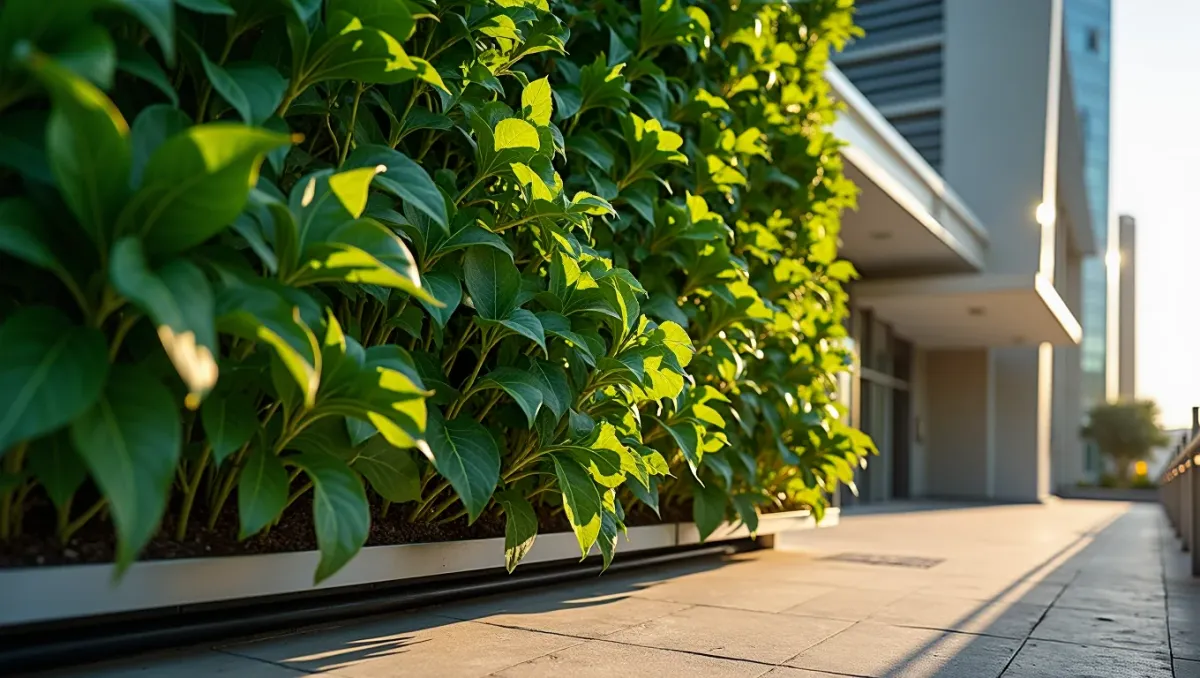
To mitigate these structural risks, commercial leaders must look beyond conventional building envelopes. We must treat the entire facility—including its façade and surrounding public spaces—as an integrated energy asset. Among the most powerful strategies is the incorporation of green walls (or vertical gardens). For large-scale industrial campuses, corporate headquarters, and mixed-use developments across the Arabian Gulf, these living systems are not merely decorative; they represent a quantifiable investment in passive cooling capacity, surface temperature reduction, and long-term operational stability. Understanding how to build a green wall is key to achieving this resilience.
The Role of Vertical Gardens in the Arabian Gulf Climate
From an energy consultancy perspective, we view green walls as advanced bio-climatic insulation systems. Fundamentally, a vertical garden is a structure that supports living plant material on the exterior surface of a building. Unlike simple cladding or painted façades, these structures use vegetation to create a complex microclimate buffer zone between the built environment and the outside air.
In the context of the Arabian Gulf—a region defined by intense solar irradiance (averaging 5.5-6.5 kWh/m²/day in KSA), prolonged high ambient temperatures, and arid conditions—the necessity of green infrastructure transcends mere sustainability mandates. It becomes an immediate operational risk mitigation tool. The primary concern in this geographical area is the Urban Heat Island (UHI) effect. When vast expanses of concrete, asphalt, and glass absorb solar radiation throughout the day, they retain heat long into the night, dramatically raising ambient temperatures. This localized overheating significantly increases the thermal load on commercial buildings.
For a developer or facility manager responsible for massive industrial loads in areas like the Eastern Province, understanding UHI is crucial because it directly translates into higher HVAC consumption. When the surrounding environment is hotter, the cooling system must work harder and longer to maintain setpoint temperatures inside. This escalating energy demand creates an exponential increase in operational expenditure (OPEX). By strategically integrating green walls, you are essentially deploying a natural heat sink that intercepts solar radiation before it hits the building envelope, thereby directly reducing the required mechanical cooling capacity.
Furthermore, from a resilience standpoint, these systems help manage dust accumulation and air quality. The structural complexity of the wall acts as a natural filtration medium, trapping particulate matter—a critical consideration given the frequent haboob storms and fine desert sand characteristic of the region. This contributes to better indoor air quality, which is increasingly linked to occupant productivity and overall operational health metrics.
Energy Benefits: Passive Cooling from Living Façades
To speak of green walls solely in aesthetic terms minimizes their profound contribution to energy economics. Their most valuable function lies in thermodynamics—specifically, how they manipulate heat transfer through the processes of shading, evapotranspiration, and surface albedo modification.
The Principle of Evaporative Cooling
When plants transpire (release water vapor into the atmosphere), they draw latent heat from their immediate surroundings. This process is natural, continuous, and highly effective at cooling the air immediately adjacent to the façade. For a large commercial structure, this localized reduction in temperature means that the incoming air—the air drawn into your building’s HVAC system—is significantly cooler than it would be otherwise.
This difference directly reduces the required mechanical energy input. A less hot intake air stream means the chiller units have to run at a lower capacity and for fewer hours, resulting in measurable savings on electricity costs. These savings move the green wall from an "expense" category into a powerful capital recovery asset.
Shading and Thermal Mass Reduction
The density of foliage provides dynamic shading throughout the day. Unlike fixed architectural elements like louvers, which provide shade only when positioned correctly, living plants offer continuous coverage that blocks direct solar gain at multiple angles. This prevents the building envelope materials (concrete, metal) from reaching peak surface temperatures.
Consider the exposed façade surfaces in KSA and UAE during peak summer months. These surfaces can absorb enormous amounts of heat energy, radiating it back into the surrounding air and through the structure itself. By intercepting this radiant flux, green walls significantly lower the thermal load on the building envelope, reducing conductive heat transfer into the occupied spaces.
Quantifying the ROI: Passive vs. Active Cooling
The core business outcome here is the shift from active cooling (running expensive machinery) to passive cooling (harnessing natural processes). While calculating precise energy savings requires detailed site modeling, the strategic principle remains clear: every unit of thermal load mitigated by a green wall is one less kilowatt-hour drawn from the grid. This operational efficiency translates directly into lower OPEX and a superior return on investment timeline for the initial capital outlay.
A Developer's Guide to Implementing Green Walls: System Types
Implementing these systems at a commercial or industrial scale requires treating them with the same rigor as structural engineering—they are complex, load-bearing additions that must withstand extreme environmental stressors. The choice of system is not aesthetic; it dictates the lifespan, maintenance complexity, and ultimate resilience of the investment.
Selecting for Resilience in Arid Environments
Given the challenges of high ambient dust (including saline coastal air), extreme diurnal temperature swings, and low water availability, developers must select systems optimized for robustness. We generally categorize these solutions into two primary approaches:
- Modular Panel Systems: These utilize pre-fabricated panels that hold a growing medium and root structure. They are highly scalable and offer predictable structural integration points. For high-density commercial facades in Jeddah or Riyadh, modularity allows for phased installation and precise engineering calculation of the load distribution (which is critical when designing around existing power infrastructure).
- Living Soil Substrate Systems: These integrate a deeper growing medium directly into the building structure or adjacent vertical racks. While offering superior rooting potential and potentially greater biomass, they demand more robust structural reinforcement and meticulous planning to manage moisture retention and drainage across large areas.
For commercial clients operating in high-dust, high-heat environments, the optimal approach often involves a hybrid modular system. This allows for controlled substrate depth while maximizing structural integrity and minimizing the exposure of vulnerable root systems to dust abrasion and extreme thermal cycling. The engineering focus must be on robust mounting hardware designed for lateral wind loading, especially when integrated into large industrial curtain walls found in mega-projects like KAEC.
Flora Selection: Minimizing Water Risk
The choice of plant material is arguably more critical than the system structure itself. Horticultural advice must be filtered through an economic lens: selecting native, drought-resistant Gulf flora (such as specific species of acacias, date palm varieties adapted to vertical growth, or local succulents) minimizes two major costs:
- Water Consumption: Using hyper-local flora drastically reduces the need for intensive, continuous irrigation, which is a major operational cost and a critical resource constraint in the region.
- Vulnerability: Native species are genetically adapted to local temperature swings and dust levels, leading to higher survival rates and lower failure risk compared to exotic imports. This resilience is key for long-term viability in the Arabian Peninsula.
Integration into Certification
Finally, successful integration means aligning the green wall project with global sustainability metrics. Developers should plan for how this feature contributes to major certifications like LEED or relevant local Saudi Green Building Standards. By quantifying the reduction in site energy consumption and stormwater runoff (which green walls manage naturally), the structure gains quantifiable points that improve marketability and investor appeal, thereby boosting the overall asset value.
Maintenance and Longevity: Making Your Green Wall Sustainable in KSA
In our advisory role, we always shift client focus from initial capital expenditure to total lifecycle cost. A green wall is a living system, meaning its operational costs—maintenance—are continuous and non-negotiable. Ignoring this phase guarantees failure. The planning must be holistic, addressing not just the planting but the long-term economic viability of the asset.
The Maintenance Lifecycle Protocol
Long-term success relies on a proactive maintenance schedule that covers three main pillars: structural integrity, biological health, and resource management.
1. Structural Health Checks (Risk Mitigation)
Periodic inspections must confirm that the mounting system remains resistant to corrosion from high humidity cycles and extreme temperature fluctuations. The weight of saturated substrates and mature biomass is significant; engineers must periodically verify that the structural load calculations—including wind shear forces acting on the vertical mass—are still valid.
2. Biological Management (Operational Efficiency)
Maintenance involves more than just watering. It requires specialized pruning, pest management tailored to local predators, and nutrient replenishment for the substrate. The goal is not maximum biomass at all costs, but optimized biomass that provides the greatest thermal benefit while requiring manageable upkeep. Regular assessment of species health prevents cascading failures.
3. Water and Nutrient Cycling (Cost Control)
A sophisticated drip irrigation system is essential, but it must be paired with closed-loop greywater recycling or captured atmospheric moisture collection where possible. The design should incorporate nutrient film technique (NFT) principles adapted for vertical planting to maximize resource efficiency, minimizing waste that represents sunk operational costs.
By treating maintenance as a planned expenditure—and not an emergency repair budget—developers can forecast the long-term cost of ownership more accurately. This transforms the green wall from a potential liability into a predictable, manageable asset class that actively reduces utility OPEX year after year.
Key Takeaways
- View green walls not as landscaping, but as critical passive infrastructure designed to mitigate UHI effects and reduce HVAC-related operational expenditure across the GCC.
- For the Arabian Gulf environment, select robust modular systems utilizing native, drought-resistant flora to minimize water consumption and withstand high dust/heat loads common in industrial cities like Jubail.
- Budgeting for specialized maintenance—including structural load checks and targeted biological care—is mandatory for realizing long-term ROI and ensuring asset longevity.
- The primary economic benefit is the reduction of thermal loading, allowing commercial buildings to operate more efficiently and recover capital faster than anticipated, especially when factoring in regional grid efficiency goals.
Related articles
- Designing for Resilience: Principles of Green Architecture in the Arabian Gulf
- Best Cool Roof Tiles Brands for GCC and KSA: A Guide to Thermal Efficiency
- Optimizing Commercial Assets with Sustainable Building Services in the GCC
- Sustainable Architecture in Saudi Arabia: Driving Resilience and ROI
- Sustainable Design: A Strategic Imperative for Commercial Investment in the Arabian Gulf
Explore topics: Green Building, Passive Cooling, Saudi Arabia, Gulf



